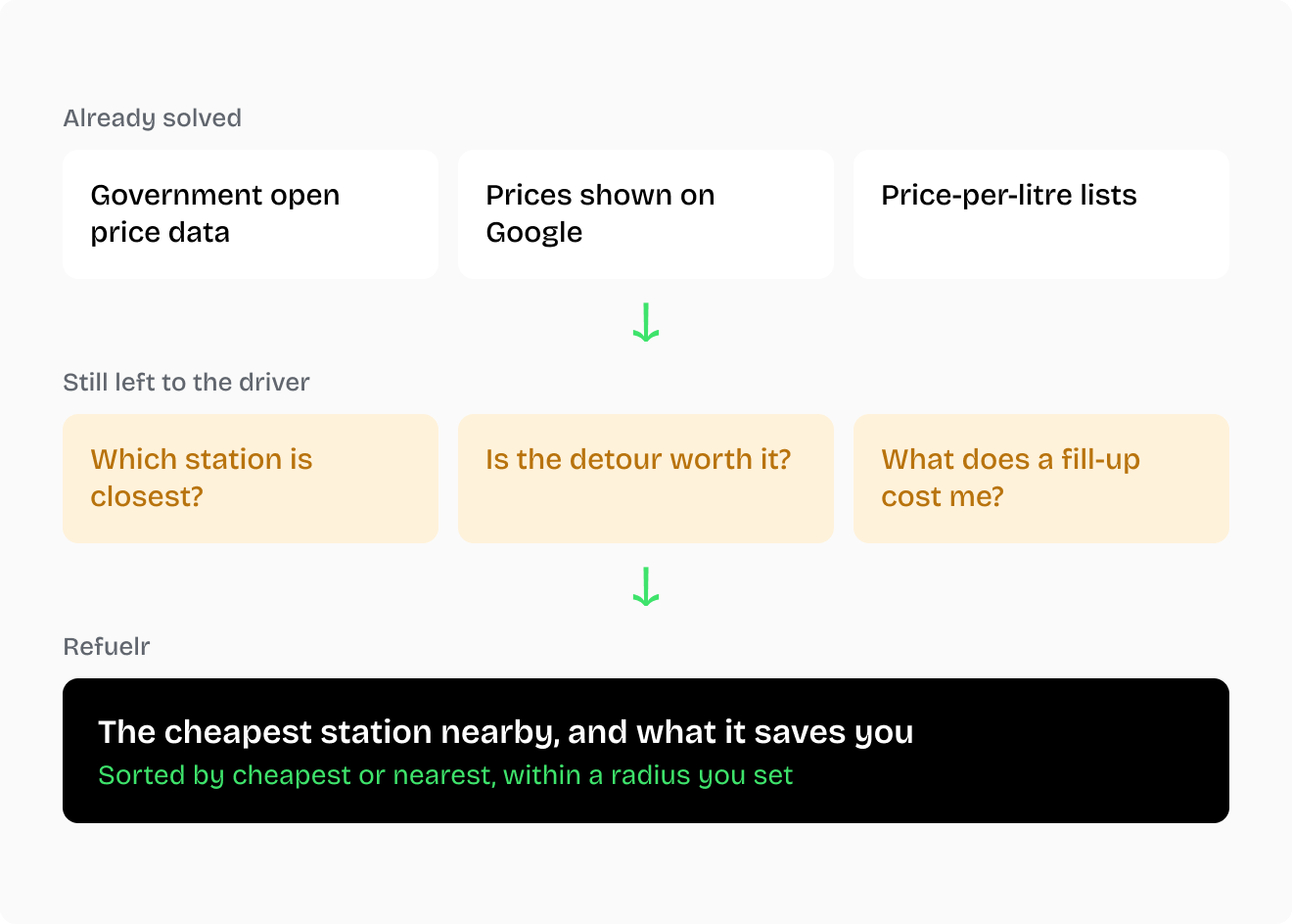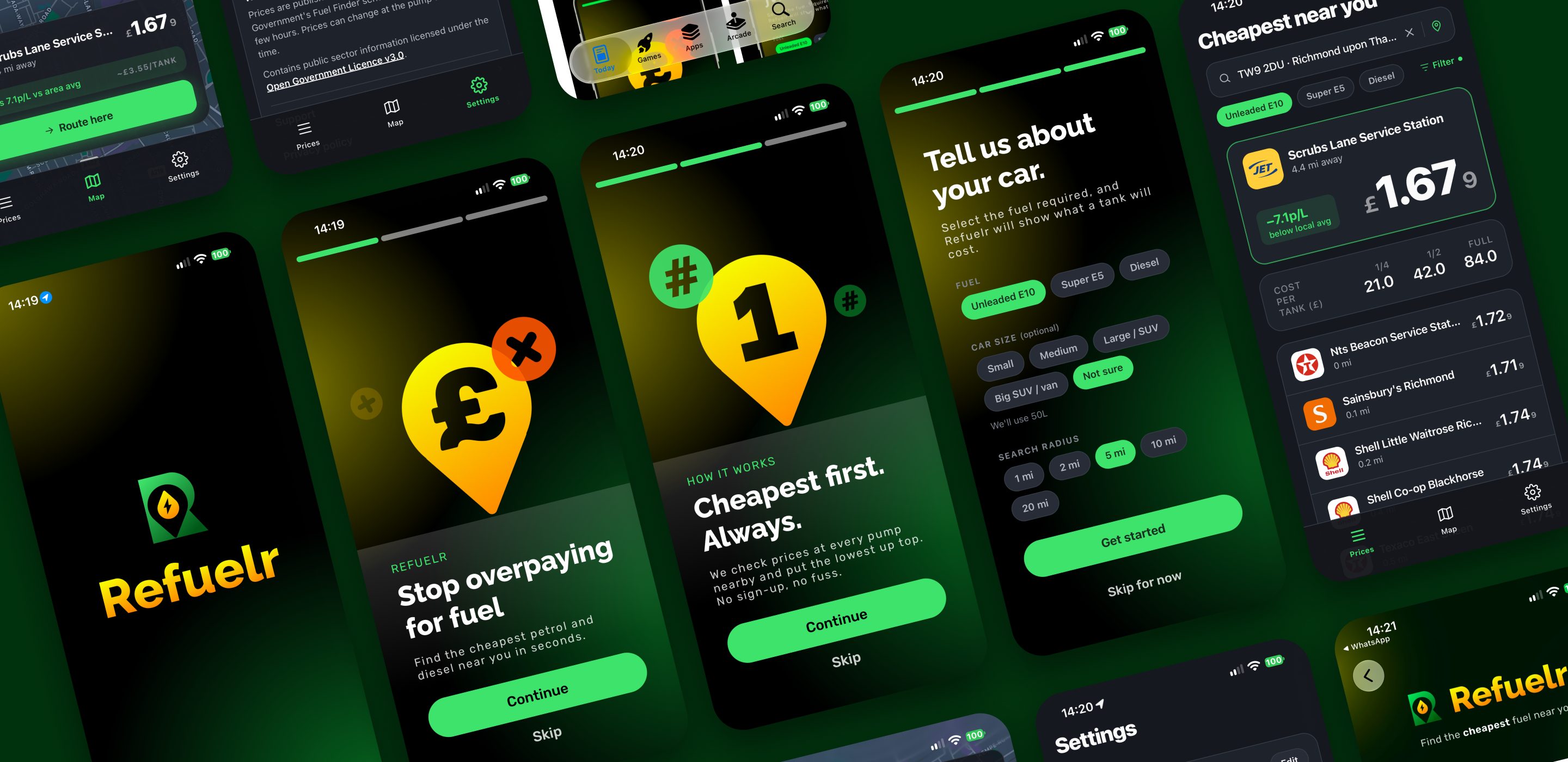
Fuel prices are public now. The government publishes them as open data, and they show up on Google. Seeing a price isn’t the hard part. Knowing which station is worth the drive is.
The cheapest station might be a long way off, and the nearest might cost noticeably more. What’s best depends on where you are, how far you’ll go, and what you drive.
Refuelr answers one question for the user:
Where’s the cheapest
fuel that’s near me?
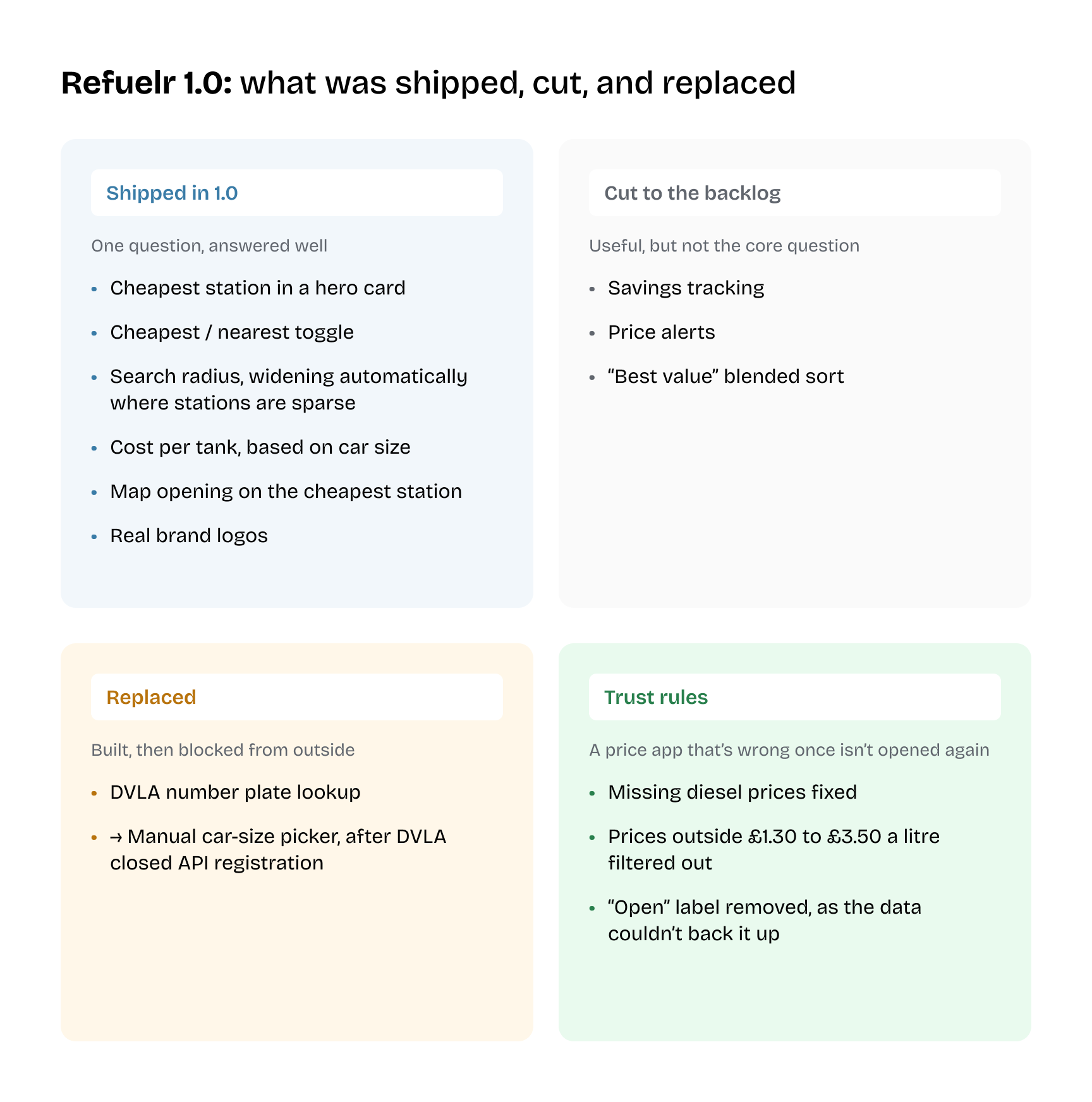
The first version tried to do too much. Savings tracking and price alerts were both built, and I cut both from 1.0. They were useful, but they pulled attention away from the one question the app had to answer well, so they went to the backlog.
The bigger risk was trust. A price app that’s wrong once doesn’t get opened again. The open data had gaps, including missing diesel prices and occasional values no forecourt would charge, so I fixed the gaps and filtered out anything outside £1.30 to £3.50 a litre. I also removed an “Open” label, because the data couldn’t reliably back it up.
So the brief wasn’t just “show the prices,” it was to show one answer people can trust, and let them check the rest.
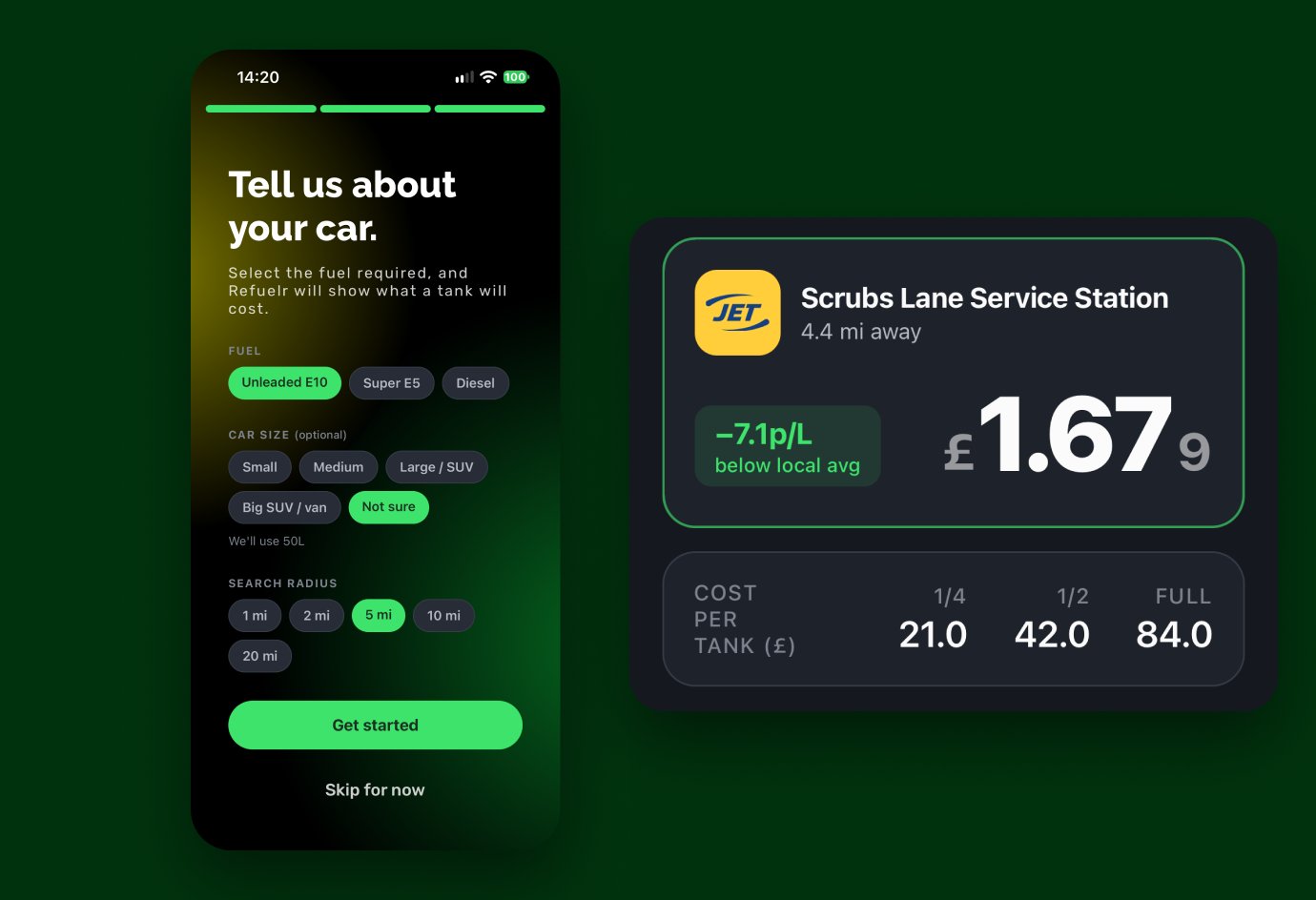
Some constraints came from outside. I built a number plate lookup using the DVLA API, then DVLA closed API registration. I replaced it with a simple car-size picker, which still gives a per-tank cost without asking for a registration.
I built Refuelr myself, with Claude Code as my main development agent for code changes, git and debugging. It went from an HTML prototype to a React app, then into a native iOS build with Capacitor and Ionic Appflow. Building it rather than drawing it meant I could test each decision on a real phone, with real prices, and cut what didn’t hold up.

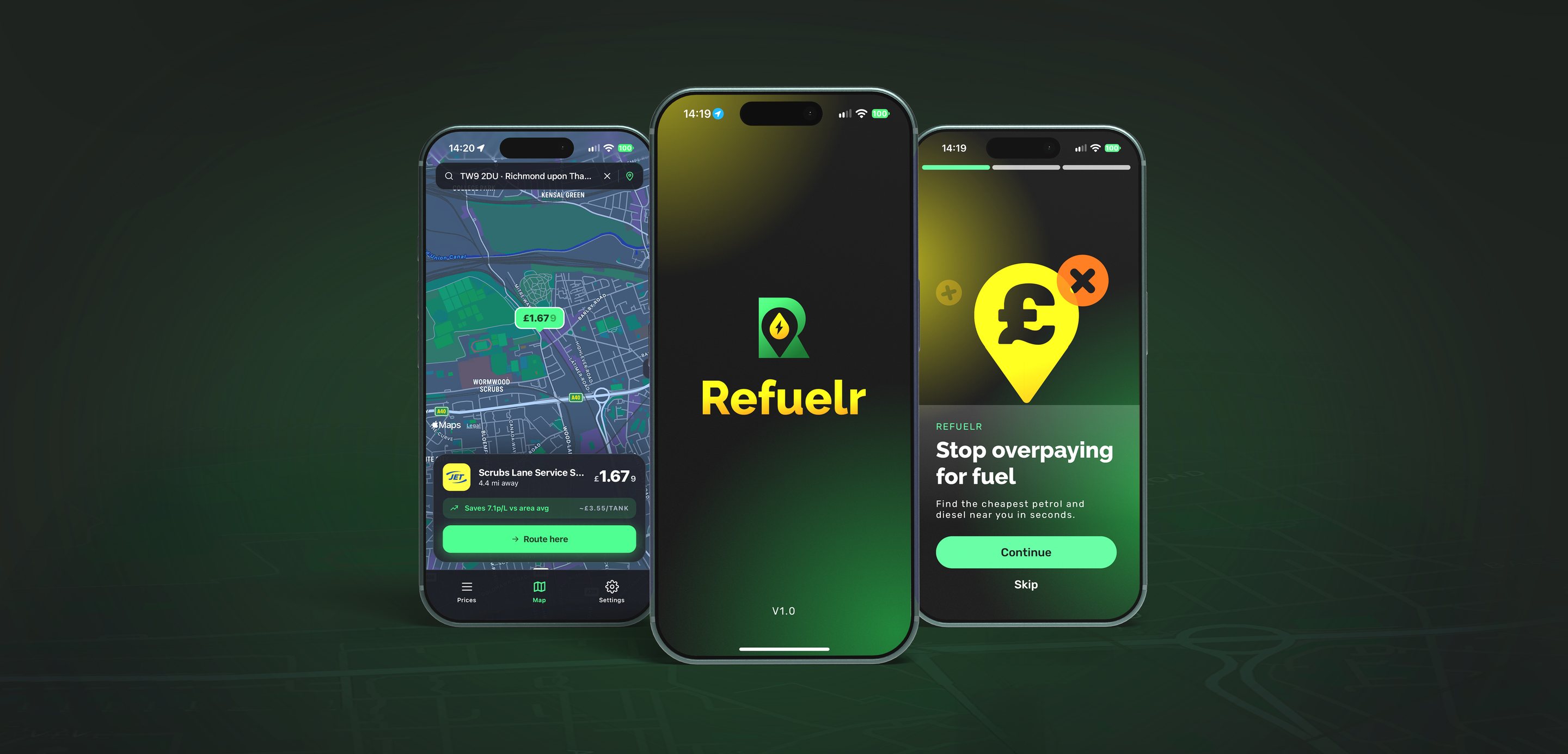
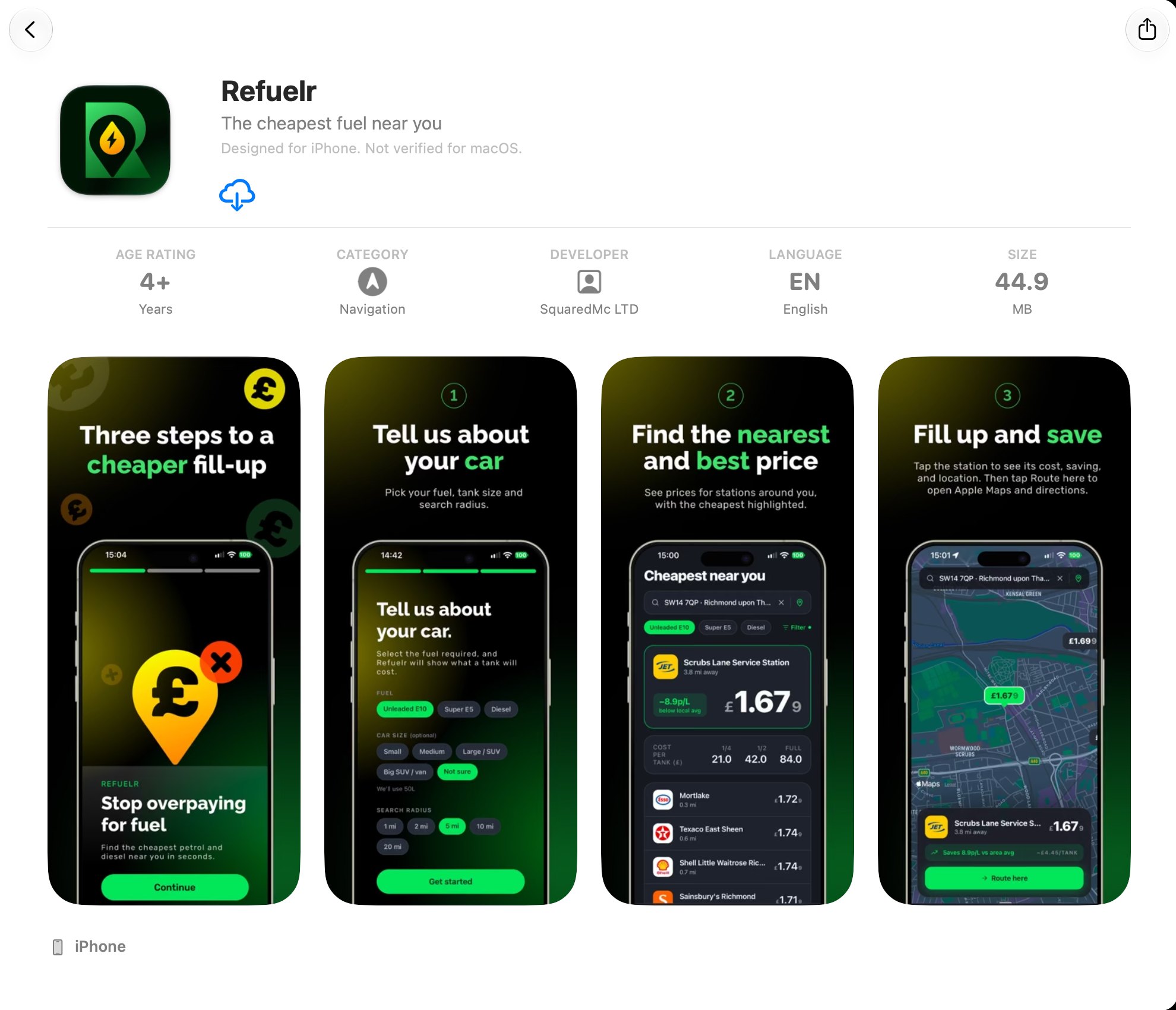
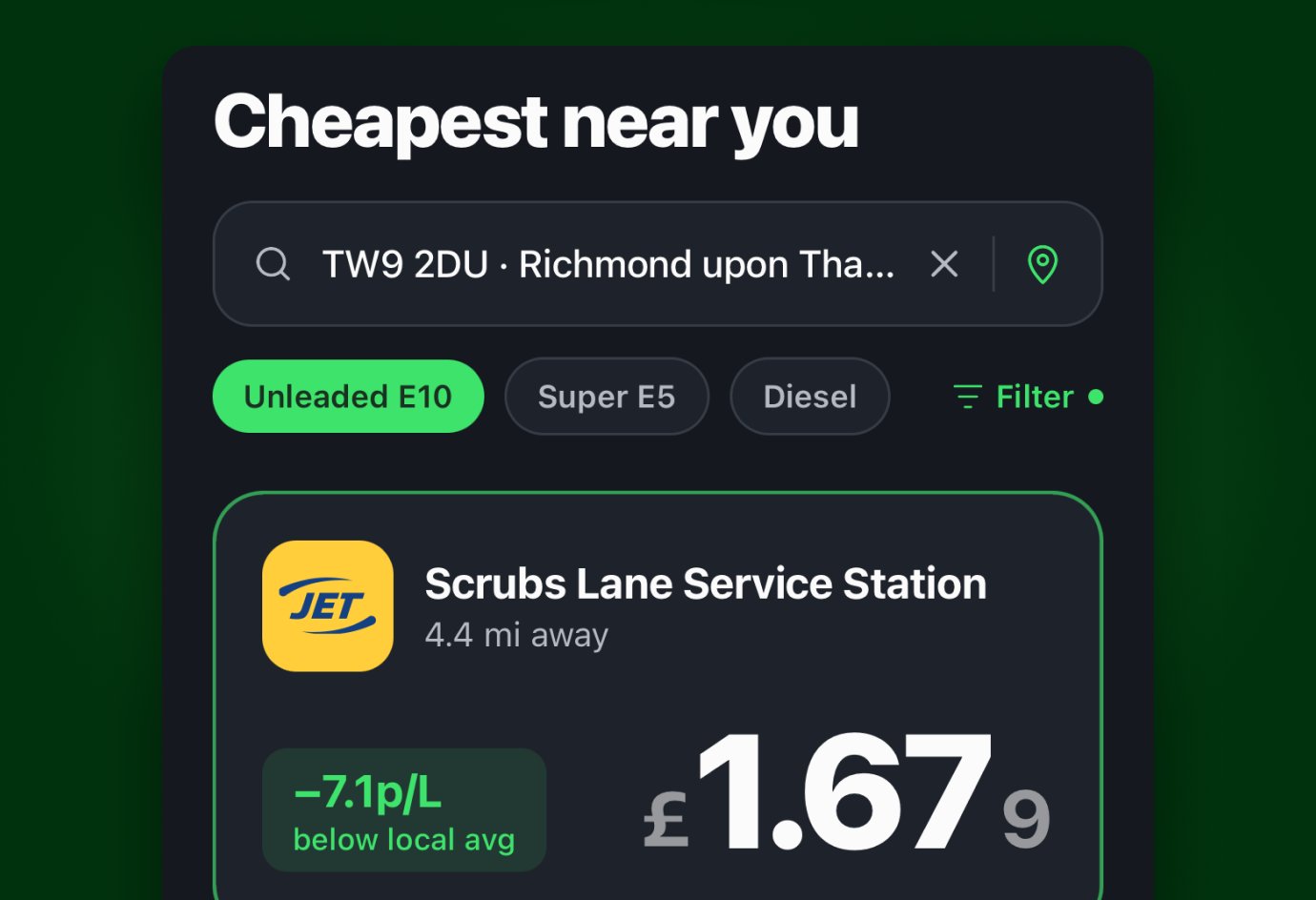
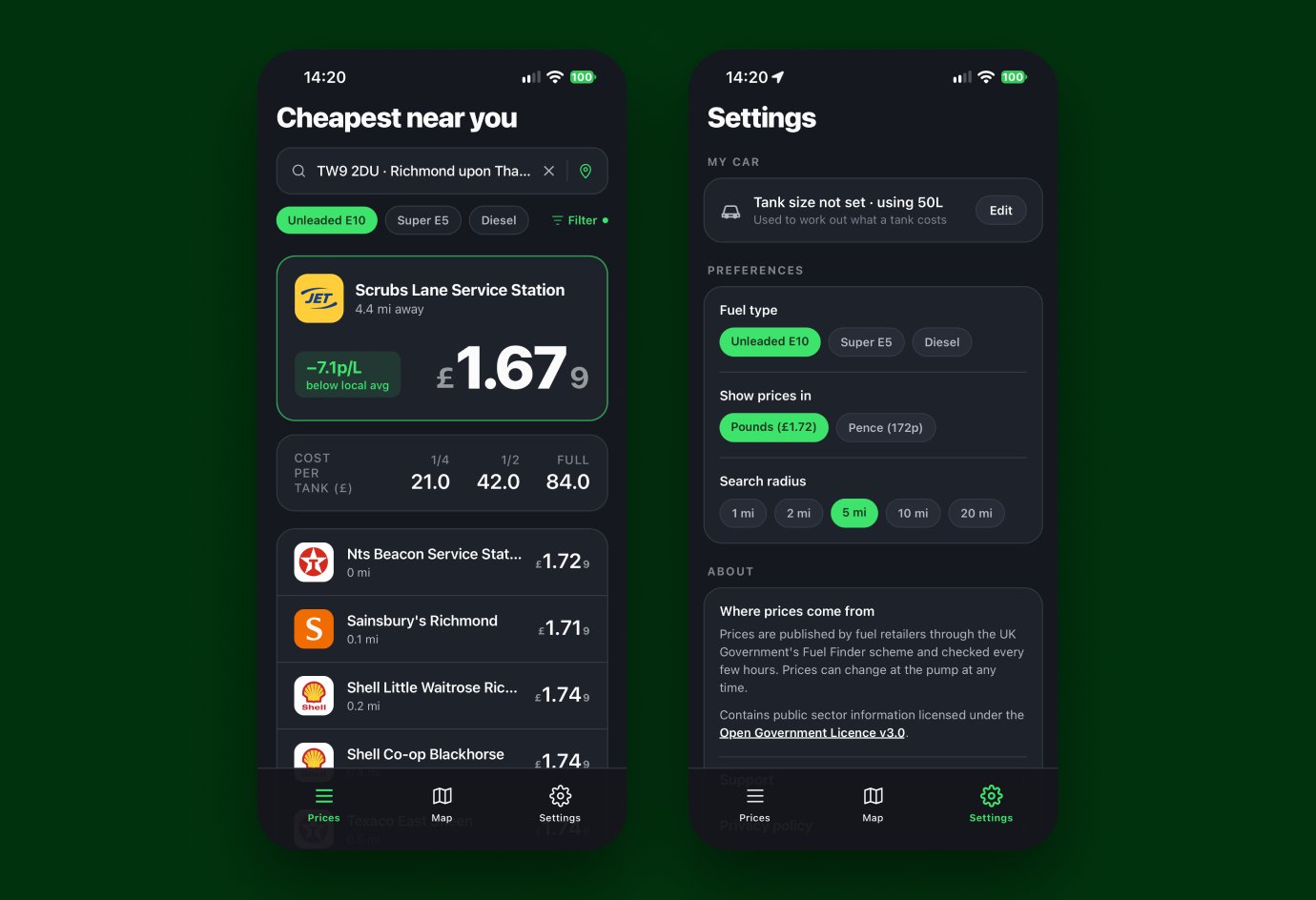
The cheapest station sits in a hero card at the top, so the answer comes before the list

Sort by cheapest or nearest within a radius you set, widening automatically where stations are sparse

Your car size turns pence per litre into what a fill-up actually costs

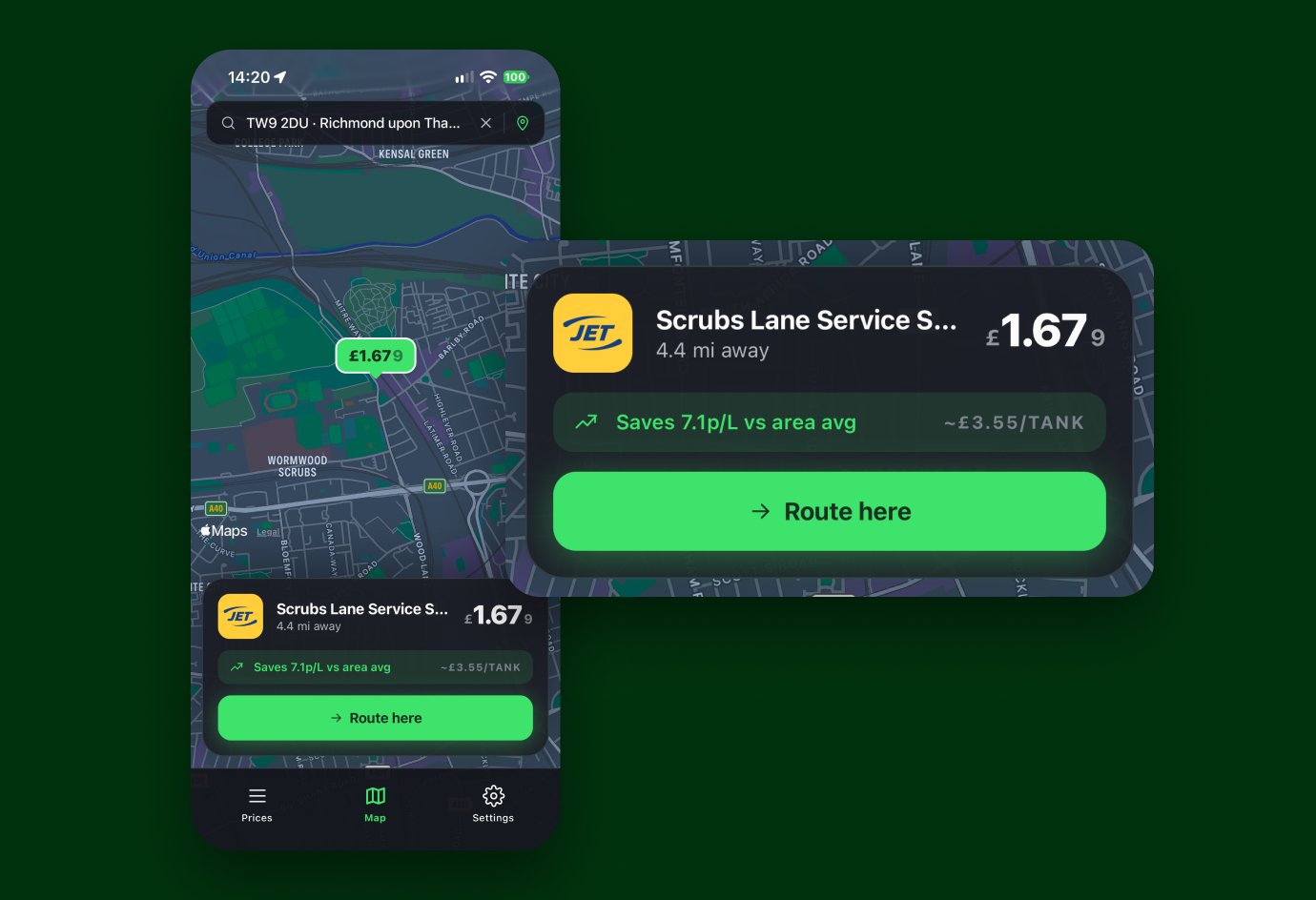
The map opens on the cheapest station, with real brand logos and coloured initials for the rest
Sainsbury’s vs JET: 5p a litre cheaper, 1.4 miles further each way
Assumes 40mpg and £1.67 a litre. Illustrative, not app output.
The obvious next step was a single “best for me” ranking that weighs the saving against the detour. In one search, a Sainsbury’s was 5p a litre cheaper than a JET but 1.4 miles further away. On a full tank that saves about £2.50. On a quarter tank, the extra driving roughly cancels it out.
I chose not to build it for 1.0. A blended score has to guess how far your car goes and how much you’re buying, and a wrong guess costs trust. So the cheapest station always sits in the hero card, and the toggle lets people choose. A “best value” sort is first on the backlog, shaped by what people actually use.
Refuelr launched on the App Store in October 2026. It covers every station in the UK’s open price data, with a deliberately small scope and a clear backlog for what comes next.
The decisions that shaped it were mostly about what to leave out: two finished features, a number plate lookup, and a ranking that would have had to guess.